by Sara Wilson, Colorado Newsline
Colorado lawmakers will once again consider a bill to place protections for people who work in extreme heat or cold, this time offering a phased approach that avoids sweeping, specific mandates on employers.
House Bill 26-1272 would direct the Colorado Department of Labor and Employment to collect data about temperature-related workplace injuries and eventually develop a model prevention plan for employers.
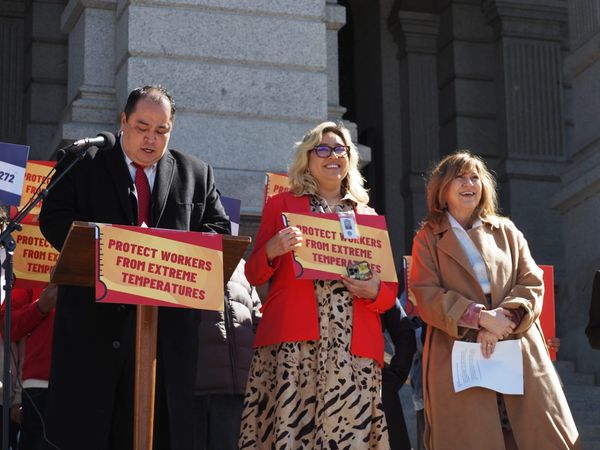
“We are in a moment where we’re seeing corporations make so much money out of the labor of the people that are here standing together,” bill sponsor Rep. Elizabeth Velasco, a Glenwood Springs Democrat, said at a press conference celebrating the bill. “We are also seeing a (presidential) administration that is rolling back workers’ protections. We want workers to have access to water during work, access to shade, making sure they know when they’re experiencing heat stroke or heat exhaustion.”
Velasco sponsored a bill last year that would have required employers to provide water for workers and set trigger temperatures for shade or shelter on the worksite. It was defeated in its first committee hearing after business groups complained of regulatory overreach. The same sponsors of that bill — Velasco, Rep. Meg Froelich, an Englewood Democrat, Sen. Lisa Cutter, a Littleton Democrat, and Sen. Mike Weissman, an Aurora Democrat — introduced this year’s version.
“I’m really proud to sponsor this legislation again this year with a new approach, including a phased rollout, to first collect data on temperature-safety practices, to encourage the state to adopt targeted standards if evidence shows that they are necessary and, finally, implement these standards on the ground,” Cutter said. “And we all know they’re going to be necessary.”
About 28,000 workplace injuries annually can be attributed to extreme heat, according to a 2025 study that analyzed Occupational Safety and Health Administration data.
HB-1272 “has the same goal to be able to protect workers if their employers require them to work during dangerous, extreme temperatures,” said Alex Sánchez, the president of advocacy organization Voces Unidas. “We are here because too many workers in this state are still expected to endure conditions that put their health, their bodies and sometimes their lives at risk.”
Under the bill, CDLE would be required to collect data on temperature-related workplace injuries and any associated compensation claims starting in 2027. By the start of 2028, the department would need to make publicly available a model injury prevention plan, and then employers — including the state and local governments — would have to submit their own plans for departmental approval by September 2028. Those plans might include strategies like cool-down or warming breaks. CDLE would also need to create training standards for employers to follow.
“The effort that we brought forward last year was very comprehensive, and it was also very prescriptive,” Velasco said. “What we heard from industry in many of our conversations was that there needs to be some flexibility, because employers are taking care of their employees in different ways depending on the industry.”
Still, the bill faces opposition from many business groups including the Colorado Farm Bureau, the Associated General Contractors of Colorado, the Colorado Competitive Council and Colorado Ski USA.
Michael Gifford, the advocacy director for AGC Colorado, wrote in an email that the organization already has a Construction Health and Safety Excellence (CHASE) partnership with OSHA that promotes job site safety, and that OSHA is not finding temperature concerns to be a major issue for construction projects in Colorado.
“We do not need this expensive, duplicate regulation, especially when [Colorado] is in a budget challenge or crisis,” he wrote.
As introduced, the bill would also carry a financial obligation for CDLE to hire more employees for the initial requirements and for state agencies to develop and implement prevention plans. A nonpartisan fiscal analysis estimates it would increase state expenditures by more than $5 million annually by 2027. The Legislature is currently weighing drastic cuts to state spending to make up an $850 million gap in the budget.
Velasco said sponsors will offer amendments in the bill’s committee hearing to “minimize” its fiscal impact. That could mean language that would direct CDLE to work with other departments that already collect relevant data about temperature-related injuries.
The bill is set for its first committee hearing on March 18.
Colorado Newsline is part of States Newsroom, a nonprofit news network supported by grants and a coalition of donors as a 501c(3) public charity. Colorado Newsline maintains editorial independence. Contact Editor Quentin Young for questions: info@coloradonewsline.com.