Montrose City Council moved forward this week on a sewer expansion that could unlock future growth in the city’s northeast quadrant, while also addressing a major budget error that threatened funding for local business and building improvement grants.
The two issues may sound unrelated, but together they point to the same challenge: Montrose is growing, and the city is trying to keep its infrastructure, budget, and economic development tools aligned with that growth.
Sewer Line at 100% Capacity
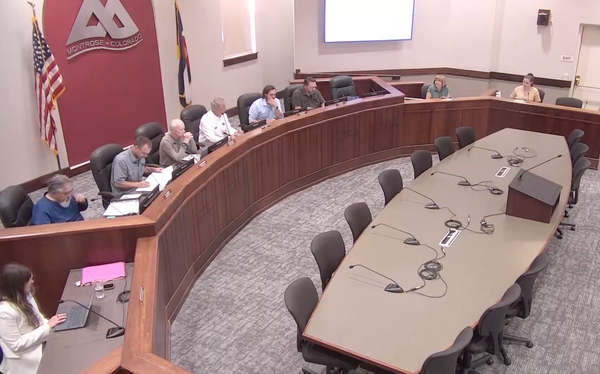
Council unanimously authorized $4,321,422 for the Capital Improvement Project 3 Sanitary Sewer Extension.
The main construction contract, valued at $4,164,322, was awarded to Mountain Valley Contracting. A separate $157,100 engineering and survey support contract was awarded to Del-Mont Consultants.
City Engineer Scott Murphy told council that the existing trunkline serving Montrose’s northeastern quadrant is currently at 100% capacity during peak flows.
That detail is important because city regulations prohibit new utility hookups on lines that are already maxed out. In practical terms, that means new residential or commercial construction permits cannot be issued in the affected corridor until the capacity issue is addressed.
For a city where growth has continued pushing northeast, the sewer project removes one of the biggest physical barriers to additional development.
Why This Project Matters
Sewer capacity is not always the most visible part of growth planning, but it is one of the most important.
New homes, shops, offices, and other buildings cannot move forward without enough water, sewer, road, and drainage capacity to serve them. When one of those systems reaches its limit, development can slow or stop even if land is available and demand remains high.
In this case, city staff made clear that the existing sewer line has reached that limit.
The $4.3 million expansion is therefore more than a maintenance project. It is a growth-enabling project for one of Montrose’s expanding areas.
For residents, that raises a broader question: as Montrose grows, how quickly can public infrastructure keep up?
Budget Error Put DART Funding at Risk
Council also addressed a significant budget error involving the city’s Development and Revitalization Team, known as DART.
DART supports grant programs for building and business owners. The program can help with improvements that support downtown investment, commercial revitalization, and small business activity.
At the council meeting, local business owners turned out during public comment to support the program.
City Manager Bill Bell and council members acknowledged that a typographical error in the 2026 municipal budget effectively reduced DART’s professional services allocation far below the intended level.
Community Initiatives Manager Michelle Wingfield explained that the amount recorded in the approved budget did not reflect what city staff intended.
Council reached consensus to restore the full allocation from the city’s Retail Sales Enhancement Fund. A formal vote is expected at a future regular meeting.
There is still some uncertainty around the exact amount that will be restored.
Source materials cited the omitted amount as $272,620. Regional reporting from the Montrose Press placed the intended figure at approximately $424,420, with only $4,200 recorded in the budget, creating a gap of roughly $420,000.
The final restored figure should be confirmed against official meeting minutes or the agenda packet for the formal vote.
What is clear is that council members agreed the error needed to be corrected and that DART funding should continue.
Charter Commission Discussion Moves Toward a Vote
Montrose councilors also discussed whether to establish a citizen-led Charter Commission to review possible amendments to the City of Montrose Municipal Charter.
A city charter functions somewhat like a local constitution. It sets the structure and powers of municipal government, including how certain decisions are made.
Council agreed to hold a formal vote at the next meeting on whether to create the commission.
If approved, the commission would give residents a formal role in reviewing potential changes to the city’s governing document.
Coin and Bullion Tax Exemption Approved
Council also passed Ordinance 2716 on second reading, creating a local sales and use tax exemption for precious metal bullion and coins.
City staff estimated the exemption will reduce annual municipal revenue by about $10,000 to $20,000.
The change is relatively small compared with larger city budget items, but it is still a policy choice with a measurable revenue impact.
Montrose County Orders Stage 1 Fire Restrictions
At the county level, Montrose County Commissioners signed an executive order imposing mandatory Stage 1 Fire Restrictions across all unincorporated county land.
The county cited declining fuel moisture levels as the reason for the restrictions.
Stage 1 restrictions are a reminder that fire risk can rise quickly as vegetation dries out. For residents outside city limits, the order means certain fire-related activities are limited or prohibited until conditions improve.
Kinikin Road Engineering Work Advances
Commissioners also advanced engineering work related to slope failures along Kinikin Road.
The road has faced ongoing problems tied to unstable soils and drainage issues. Engineering work is expected to help the county evaluate repair options and stabilize areas where the road continues to shift or fail.
The Kinikin Road issue is another example of the infrastructure pressures facing local governments across the Western Slope. Roads, drainage systems, and underground utilities all require ongoing investment, especially in areas where soil, water, and growth conditions create added stress.
The Bigger Picture
Montrose is investing in the systems that make growth possible. Sewer capacity, business grant funding, fire restrictions, and road repairs all point to the same challenge: keeping public infrastructure and local support programs ahead of demand.