2026 Election Endorsements

– 6 min read

Trellis editorial. Our news coverage of every measure, without a position, is in the Western Slope Voter Guide. This is where we tell you what we think.
Before you get to the 14 statewide measures, look at the bottom of your ballot. District 51 wants a $23.2 million override for teacher pay. Roaring Fork Schools wants $5 million for the same thing. Garfield Re-2 wants an override and a bond. Garfield County's libraries want to keep a mill that was supposed to expire, because natural gas valuations fell and took $830,000 with them. Grand Junction, Palisade and Cedaredge each want a sales tax increase for a pool, four streets, roads and police.
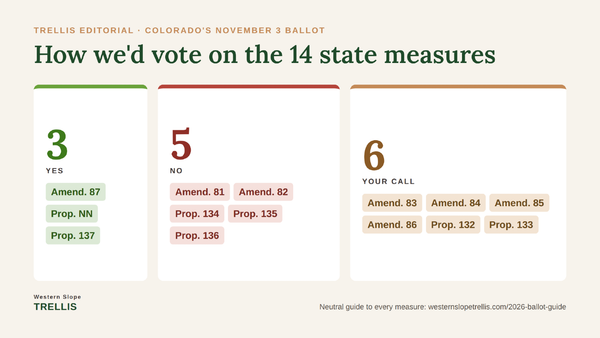
Eight local questions, every one for something that used to be covered. That is the lens we used on the state ballot. Which of the 14 measures make it easier for Western Slope communities to pay for the basics, which make it harder, and which have nothing to do with it. We come out yes on three, no on five, and on six we are not telling you how to vote.
Colorado taxes every dollar at 4.4%, whether the filer earns $40,000 or $4 million. Amendment 87 replaces that with brackets: 3.7% on the first $25,000, 4.2% up to $100,000, the same 4.4% from $100,000 to $500,000, and higher rates only on income above half a million. A household with $80,000 of taxable income pays about $285 less. The top 3% of earners pay more, and the state gains roughly $2 billion a year for the general fund that the school finance formula draws on.
Three school districts in two of our counties hit the same wall in the same month: they cannot pay teachers a competitive wage on what the formula sends. Their only tool is a property tax override, which lands on the retiree in a paid-off house and, through rent, on the tenant. Amendment 87 is the one measure on this ballot that raises school money from the top instead. A Rifle household that votes yes on Re-2 and the library mill roughly breaks even if 87 passes. That is the whole case, and it is enough.
The Legislature's own answer to the same problem. It lets the state keep revenue above the TABOR cap up to what it spends on K-12, and raises school funding by up to 2% a year for ten years. The cost is a smaller refund in years the state collects above the cap, roughly $56 for a joint filer in the first year by one estimate. Colorado is one of the wealthiest states in the country and funds its schools near the bottom. Yes, with the note that 87 is the better tool because it does not touch the refund; NN is the one the Legislature could pass, and it should not fail for lack of the other.
No new tax. It takes the sales tax already collected on sporting goods, about $175 million a year by the campaign's estimate, out from under the TABOR cap and splits it: 47.5% to Great Outdoors Colorado, 47.5% to a wildfire prevention and water fund, the rest to outdoor equity and the state recreation office. Half the money goes to forest thinning, fuel breaks and watershed work, which every fire district on the Western Slope will tell you it cannot fund fast enough. Aspen Valley Land Trust, Tri-State and Sen. Dylan Roberts are on board. The League of Women Voters opposes it on the principle that ballot-box budgeting is bad practice. That is a fair principle, and TABOR is the reason the Legislature cannot do this itself. Yes.
This measure exists to block Amendment 87. It writes the 4.4% flat rate into statute and, if both pass, the one with more yes votes prevails. It comes from Advance Colorado, which put six of this year's thirteen initiatives on the ballot and does not say who pays for them. Voters are entitled to know who is funding a campaign to keep the rate flat on income above $500,000. Until they do, no.
Two sentences in the state constitution guaranteeing the right to buy and sell natural gas. Garfield County is one of the largest gas producers in Colorado, and we understand why this sounds like a vote for the home team. It is not. The oil and gas industry's own trade groups are not behind it; they say they are holding to the 2024 truce with the governor. What the amendment does is freeze building codes and utility plans in the constitution, where the next Legislature, the next PUC and the next town council cannot touch them. Your furnace is not in danger. Your ability to change the rules later is. That does not belong in the constitution. No.
Requires local officers to determine whether anyone they charge with a violent crime, or who has a prior felony, is lawfully in the country, and to notify Homeland Security within 72 hours if they are not, or if their status cannot be determined. Mesa County has already lived through what this looks like in practice: a deputy shared a traffic stop with federal agents, a young woman spent two weeks in detention, and the sheriff apologized and disciplined five people. Garfield's sheriff is fighting a cease-and-desist letter over jail holds. Local police answer to local voters and work only when residents will call them. Federal immigration enforcement is a federal job with a federal budget. Making the first do the second's work, in the constitution, is a no.
Requires every K-12 and college team, down to intramurals, to be designated male, female or coed, with the definitions written into statute. Colorado's high school athletic association and its schools already have a process for this, run by the people who know the kids involved. Whether a particular child plays on a particular team is a decision for that child, their parents and their school. The state does not need to mandate it. No.
Prohibits gender-transition surgeries for anyone under 18 and bars Medicaid and insurance from covering them. These surgeries are rare, they are already decided case by case by families and physicians, and the measure puts the state between a parent, a child and a doctor. No.
On these we do not have a position, and we are not going to invent one. Here is what we would weigh.
Amendment 83, right to hunt and fish. Hunting is a $27 million business in Mesa County alone and this region has voted against every wildlife-restriction measure by wide margins, so the sentiment is real. The question is whether writing "preferred method" into the constitution moves wildlife decisions from Colorado Parks and Wildlife into the courts. Read both sides in the guide.
Amendment 84, ID numbers on mail ballots. It keeps the signature and adds four digits of an ID number, with a way to fix mismatches. Mesa County's clerk is already contacting 4,000 young voters whose signatures are thin on file. Ask whether the added step catches fraud the signature check missed, or mostly catches voters who forgot a number.
Amendment 85, plain language ballots. Nobody is against an eighth-grade reading level. Ask whether the constitution is where a style rule belongs.
Amendment 86, mid-decade redistricting. The map it is written to block would have moved most of Garfield County into a different congressional district. The Supreme Court already killed that map. What is left is a rule for next time, and it is sponsored by the same group behind 136, 81 and 82.
Proposition 132, fentanyl penalties. Mesa County's overdose deaths have fallen from 44 to 30 in three years without it. Possession of a gram or less becomes a felony with a treatment path; distribution carries a mandatory 8 to 32 years. The sheriff and the district attorney disagreed about this approach in 2022. Both are worth listening to.
Proposition 133, child sex trafficking. Life without parole, and a broader definition of the crime. Hard to argue with the sentence. Read the definition.
We are not going to tell you how to vote on your own school district, your own library or your own pool. Those are the questions where you know more than we do. We will say this: every one of them is asking for the basics, none of them is padded, and the arithmetic changes depending on what happens at the top of the ballot. If Amendment 87 passes, most Western Slope households can afford a yes on their local questions and come out about even. If it fails and 136 passes, every local yes comes straight out of your pocket.
That is why the state measures come first.
Trellis editorials are written by the publisher and are separate from our civic reporting. Disagree? Write to westernslopetrellis@gmail.com and we will run the best responses.