2026 Ballot Guide
he 14 statewide measures and every local question we could confirm in Mesa, Montrose, Garfield and Delta counties, with what each one means from here. Updated through Election Day

he 14 statewide measures and every local question we could confirm in Mesa, Montrose, Garfield and Delta counties, with what each one means from here. Updated through Election Day

Last updated Sept. 9, 2026. This guide will be updated through Election Day as clerks assign ballot letters and jurisdictions publish final figures.
Your ballot this fall is going to be long. The Colorado Secretary of State certified 14 statewide measures on Friday, which ties the record for the most questions put to voters in at least 52 years. Thirteen of them got there by petition, the most citizen initiatives on a single Colorado ballot since 1974, according to Colorado Newsline's review of the state database.
And that's just the top of the ballot. Below the state questions, Grand Junction voters will decide whether to rebuild the Orchard Mesa pool, District 51 is asking for a $23.2 million mill levy override, Palisade wants its first sales tax increase in about 30 years, Montrose voters will weigh four changes to the city charter, and Garfield County has a library levy and two school district packages on the line.
One thing you will not see: the Colorado Connector passenger rail tax. That 0.333% sales tax question, Ballot Issue 7A, goes only to voters in Front Range communities between Fort Collins and Pueblo. No Western Slope jurisdiction votes on it.
Dates that matter
Nonpartisan analysis of every state measure arrives in the Blue Book, which the Legislature mails to registered voters and posts at leg.colorado.gov/bluebook.
Local governments had until Sept. 4 to certify their questions to the county clerks. Each item below is sourced to the jurisdiction's own documents or to news reports, linked inline. Clerks assign ballot letters after certification, so letters will follow. This list covers what we could verify; a town or district that is missing may still have a question, and the clerk's office is the place to check.
Grand Junction: Orchard Mesa pool. City Council voted unanimously in August to ask for about $12 million in debt (roughly $19 million with interest over 15 years) to rebuild the 1983 pool, paid for by a sales tax increase from 3.39% to 3.46% starting Jan. 1, 2027. Roughly half the money services the debt and half subsidizes operations; the rate steps down once the debt is paid. The city's own survey found 38% in favor of the tax and 43% opposed, the Daily Sentinel reported.
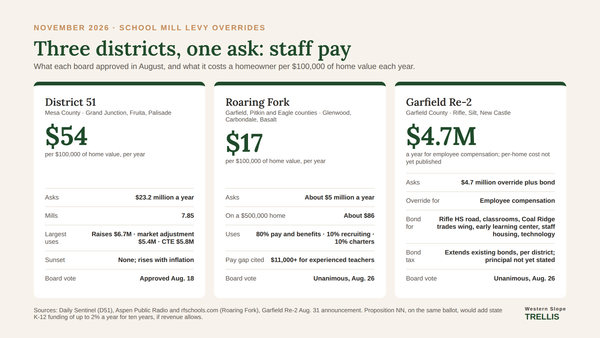
School District 51: $23.2 million mill levy override. The board approved the language Aug. 18. The 7.85-mill override costs about $54 a year per $100,000 of home value, has no sunset, and would fund staff raises ($6.7 million), a 5% teacher market adjustment ($5.4 million), career and technical education ($5.8 million), safety and security, STEAM programs, and the charter schools' share. Teacher pay would move from a range of $50,765 to $105,998 up to $53,303 to $111,298.
Palisade: sales tax from 2% to 3%. Trustees voted unanimously Aug. 25. The increase would raise about $600,000 in its first year for roadwork on 4th through 7th streets, park irrigation and trees, the pool, and emergency services, and it sunsets after eight years. Town Manager Janet Hawkinson called it Palisade's first sales tax increase in about three decades. A similar question failed in 2024.
City of Montrose: four charter amendments. On a 3-2 vote, council sent voters four separate questions: move city elections from April to November; set an eight-year lifetime term limit for council members; require council approval before the city manager hires or fires the police chief; and the same council approval for the city clerk. The city's proposed amendment text keeps day-to-day supervision of both positions with the city manager. Nine amendments were floated this summer; five were dropped. Mayor Michael Badagliacco and councilors Adam Woodden and Ed Ulibarri voted yes. Councilor J. David Reed voted no, telling the Montrose Daily Press he sees "a growing effort to inject partisan politics into a municipality that our charter deliberately makes non-partisan."
We did not find a certified question from Montrose County, Olathe, Montrose County School District RE-1J, the recreation district or the fire districts. Clerk Tressa Guynes's office has the full list of what is coordinating on the county ballot.
Garfield County Libraries: keep 1 mill. One mill of the levy voters approved in 2006 to build six branches expires in 2027 when the bonds are paid off. The district is asking to keep collecting it from 2028 on, with no sunset. That means the tax rate stays the same, but property owners keep paying a mill that would otherwise come off their bill. Library director Jamie LaRue, in a March column, put the figure at about $1 million a year, or roughly $38 a year on a median home. "It's not raising any taxes, it's an extension of the mill levy," board president Adrian Rippy-Sheehy said when commissioners voted 2-0 on Aug. 18 to place it on the ballot. The district lost more than $830,000 this year as natural gas valuations fell.
Roaring Fork Schools: mill levy override. The board voted unanimously Aug. 26 to ask for about $5 million a year, roughly $17.25 per $100,000 of home value, or about $86 on a $500,000 home. Eighty percent goes to salaries and benefits, 10% to recruitment and retention, 10% to the district's charter schools. The district says its experienced teachers earn more than $11,000 less than peers in comparable districts, and its average teacher more than $5,500 less.
Garfield Re-2 (Rifle, Silt, New Castle): override plus bond. The board voted unanimously Aug. 26 to put two questions on the ballot: a mill levy override for staff pay, and a bond the district describes as extending the current bond without a new tax, for facilities, staff housing, early childhood and technology. The district announcement cited here does not give dollar amounts. We will add them when they are published.
We did not find a certified 2026 question from Glenwood Springs, Rifle, Carbondale, New Castle, Silt, Parachute, Garfield 16 or the fire districts.
Cedaredge: sales tax from 1.5% to 2.5%. Trustees voted 5-2 to send voters a one-point increase worth about $200,000 a year, with minimum shares written in: 20% roads, 20% recreation, 20% police, 15% economic development.
Headings use the official titles assigned by the Secretary of State, which is how each measure appears in the Blue Book. Summaries come from the initiative texts, linked on each one. Constitutional amendments need 55% to pass. Statutory propositions need a simple majority, and so does Amendment 87, because it only repeals language rather than adding it. Six of the 13 initiatives come from Advance Colorado, a conservative group that does not disclose its donors.
Writes a right to hunt and fish "by traditional methods" into the constitution and names hunting and fishing the state's preferred way of managing wildlife. The Legislature and Colorado Parks and Wildlife could still set seasons, limits and licenses. Federally protected species, including wolves, are excluded, and it creates no right to enter private land. Backed by the International Order of T. Roosevelt, a national hunting group whose CEO Luke Hilgemann formerly ran Americans for Prosperity, working with Dan Gates of Coloradans for Responsible Wildlife Management, who led the campaign against the 2024 mountain lion hunting ban.
Western Slope: This is the measure with the deepest roots here. The most recent state economic study, using 2017 data, put hunting alone at $26.9 million and 392 jobs a year in Mesa County, $15.2 million in Garfield and $8.3 million in Montrose, before counting fishing. Our counties have voted against the two recent wildlife measures by wide margins: the 2024 lion ban drew 33% yes in Mesa and Garfield and 28% in Montrose, and 2020 wolf reintroduction drew 31% in Mesa, 37% in Garfield and 24% in Montrose, per the state's 2024 and 2020 results. Opponents, including a committee organized by Steamboat Springs hunter Eric Washburn, argue the amendment moves wildlife disputes from CPW's commission into the courts.
Two sentences guaranteeing consumers the right to buy natural gas for heating and cooking, and utilities the right to sell it. Aimed at state and local electrification rules like the Public Utilities Commission's clean heat plan and all-electric building codes. Advance Colorado. The oil and gas industry's own trade groups are not behind it; they say they are sticking to the 2024 truce brokered by Gov. Polis.
Western Slope: Garfield County is one of the state's largest gas producers, with nearly 12,000 active Piceance Basin wells as of 2023, and oil and gas made up more than half the county's assessed value in 2022. The library levy above is on the ballot partly because gas valuations dropped. Black Hills Energy delivers gas to the Glenwood-to-Rifle corridor, Delta and Montrose; Xcel serves the Grand Valley. For a household, the practical question is whether future building codes and utility plans can steer new homes and furnace replacements toward electric heat. The amendment would not change what your current furnace or stove burns.
Requires peace officers, corrections officers and prosecutors' investigators to make a reasonable effort to determine whether a person they charge is lawfully in the country, and to notify the Department of Homeland Security within 72 hours when that person is charged with a crime of violence or has a prior felony conviction and is either not lawfully present or their status is still unknown after that effort. It overrides state laws that currently limit this cooperation. Advance Colorado.
Western Slope: The Mesa and Garfield county sheriffs have been in the middle of this fight already. In 2025 a Mesa County deputy shared a traffic stop of Caroline Dias Goncalves with federal agents through a group chat; she was held about two weeks, Sheriff Todd Rowell apologized and disciplined five employees, and his countersuit against the state's cooperation limits was dismissed in July. Garfield County Sheriff Lou Vallario received a cease-and-desist letter in February over ICE holds at his jail and has said he will hold inmates up to six hours at ICE's request. The amendment would make notification mandatory in the cases it covers, and would apply to people whose status simply could not be determined.
Voters would still sign the return envelope, and would also have to write in the last four digits of their Social Security number or Colorado driver's license or ID number. If the number does not match the voter file, the clerk must notify the voter and give them a way to correct it, in person or digitally, with a copy of an ID. Backed by the Coalition for American Prosperity and Growth.
Western Slope: Mesa County's clerk's office is already contacting about 4,000 voters ages 17 to 25 who have one or no reference signature on file so their ballots are not rejected at higher rates. The 2024 Mesa County stolen-ballot case, a dozen ballots submitted in other people's names, was caught by signature checks.
Requires future ballot measures to be written at an eighth-grade reading level. Advance Colorado.
Any redrawing of congressional lines between censuses would need approval from the independent redistricting commission and the state Supreme Court, and could not be drawn to favor a party. Advance Colorado.
Western Slope: The map this is designed to block would have hit us directly. A Democratic-aligned proposal this spring would have moved Moffat, Rio Blanco and most of Garfield County into the 2nd District and added Eagle and Summit to the 3rd, with the goal of unseating Rep. Jeff Hurd. The Colorado Supreme Court threw those initiatives out in June, so no map is on this ballot, only the rule for future ones.
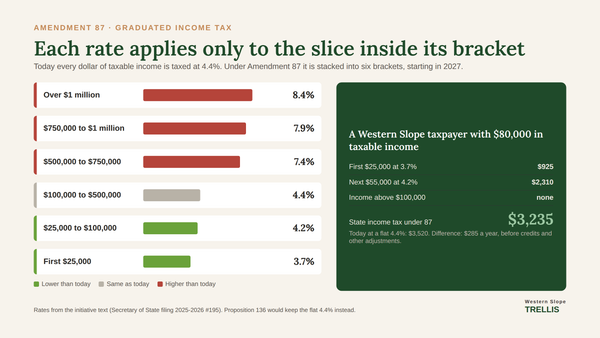
Amendment 87 replaces Colorado's flat 4.4% income tax with six brackets starting in 2027. Each rate applies only to the slice of income inside that bracket, the way federal taxes work, so a filer with taxable income of $600,000 pays the higher rate only on the last $100,000.
| Taxable income | Rate |
|---|---|
| Up to $25,000 | 3.70% |
| $25,000 to $100,000 | 4.20% |
| $100,000 to $500,000 | 4.4% |
| $500,000 to $750,000 | 7.40% |
| $750,000 to $1 million | 7.90% |
| Over $1 million | 8.40% |
The same brackets apply to corporations. Profit from selling a primary home, above the federal exclusion, stays at 4.4%. The new revenue is exempt from the TABOR cap. Backed by Protecting Colorado's Future, a coalition of progressive groups. Proposition 136, from Advance Colorado, caps the income tax rate at 4.4% in statute. If both pass, the state constitution (Article V, Section 1) says the conflicting provisions of the measure with more yes votes prevail. Amendment 87 is a constitutional amendment and Proposition 136 is a statute; the Blue Book analysis should address how those interact.
Western Slope: Western Colorado Alliance, the Grand Junction-based organizing group, is part of the coalition behind Amendment 87 and is pitching it as a tax cut for 97% of filers. A filer with $80,000 of taxable income would owe about $3,235 under the new brackets instead of $3,520 today, a $285 difference before credits and other adjustments.
The one measure the Legislature referred. It lets the state keep and spend revenue above the TABOR cap up to the amount it spends on K-12, and uses that room to raise K-12 funding by up to 2% a year, compounding, for ten years, with the higher level maintained after that. Money left after the school increase goes to disability services, school services and child care. It passed on party lines with no Republican votes. Colorado Newsline puts the eventual figure at about $500 million a year; the cost to you is a smaller TABOR refund in years the state collects above the cap.
Western Slope: The statewide yes campaign launched in Clifton, at Rocky Mountain Elementary, with D51 Superintendent Brian Hill and board president Jose Luis Chávez, though the D51 board has not formally endorsed. Rep. Meghan Lukens of Steamboat was a prime sponsor and Rep. Elizabeth Velasco of Glenwood co-sponsored. Voters in D51, Roaring Fork and Re-2 will be deciding this alongside their own local override requests, If the local overrides pass, property taxes in those districts go up; if NN passes, TABOR refunds shrink in years the state collects above the cap.
Makes possession of any amount of fentanyl a felony. Possession of one gram or less of material containing fentanyl becomes a "treatment-mandated" felony: qualifying defendants are eligible for court-ordered treatment, and the conviction can be vacated if they complete it. Larger amounts are ordinary felonies. Distributing any amount becomes a level 1 drug felony with a mandatory prison sentence of 8 to 32 years. Advance Colorado. The state's fiscal analysis estimates prison costs reaching about $68 million a year by the fifth year.
Western Slope: Mesa County recorded 30 overdose deaths in 2025, down from 44 in 2022; about a third involved opioids, mostly fentanyl, and more involved methamphetamine. In 2022 Sheriff Rowell called for a felony for any amount, saying that charge "carries the weight to get addicts into treatment," while District Attorney Dan Rubinstein told lawmakers "we're really not looking to felonize drug addiction."
Expands the crime of trafficking a minor for sexual servitude to include trading anything of monetary value to buy or sell sexual activity with a minor, and sets the sentence at life without parole. Current law carries 8 to 48 years. Backed by Protect Kids Colorado, whose proponents Erin Lee and Michelle Austin are also behind the next two.
Requires K-12 and college teams, including intramurals, to be designated male, female or coed. It defines male and female by whether a person's reproductive system is organized around producing sperm or ova, which would bar transgender girls and women from female teams. Its one exception runs the other way: a female athlete may join a male team when no female team is offered. Coed teams stay open to everyone.
Prohibits health care providers from knowingly performing surgery on anyone under 18 to alter their sex characteristics, meaning gender-transition surgeries. Treatment for a medically verifiable disorder of sex development, treatment for acquired abnormalities and circumcision are excluded. It also bars state funds, federal funds, Medicaid reimbursement and insurance coverage from paying for the prohibited surgeries.
Redirects the state sales tax already collected on sporting goods, so it is kept outside the TABOR cap and split four ways: 47.5% to Great Outdoors Colorado, 47.5% to a new wildfire prevention and water fund, and 2.5% each to outdoor equity grants and the state outdoor recreation office. The campaign estimates about $175 million a year. No tax rate changes; the money comes out of the general fund and TABOR refunds instead. Backed by The Nature Conservancy.
Western Slope: Roughly half the money would go to the state programs that fund forest thinning, fuel breaks and watershed protection on the Western Slope. Endorsers include Aspen Valley Land Trust, Tri-State Generation and Transmission, Sen. Dylan Roberts, Rep. Velasco and Ridgway Mayor John Clark. The League of Women Voters of Colorado opposes it.
Mesa County ballots go in the mail Oct. 2. Between now and then, watch for standalone posts on the Orchard Mesa pool, the D51 override, the Montrose charter questions and the Garfield library levy. Figures and wording will be updated as jurisdictions publish them. If your town or district has a question we missed, email us.