ID numbers on mail ballots and two other voting amendments
Amendments 84, 85 and 86 would change how mail ballots are checked, how ballot questions are written, and when congressional maps can be redrawn. Mesa County has history with the first and a stake in the third.
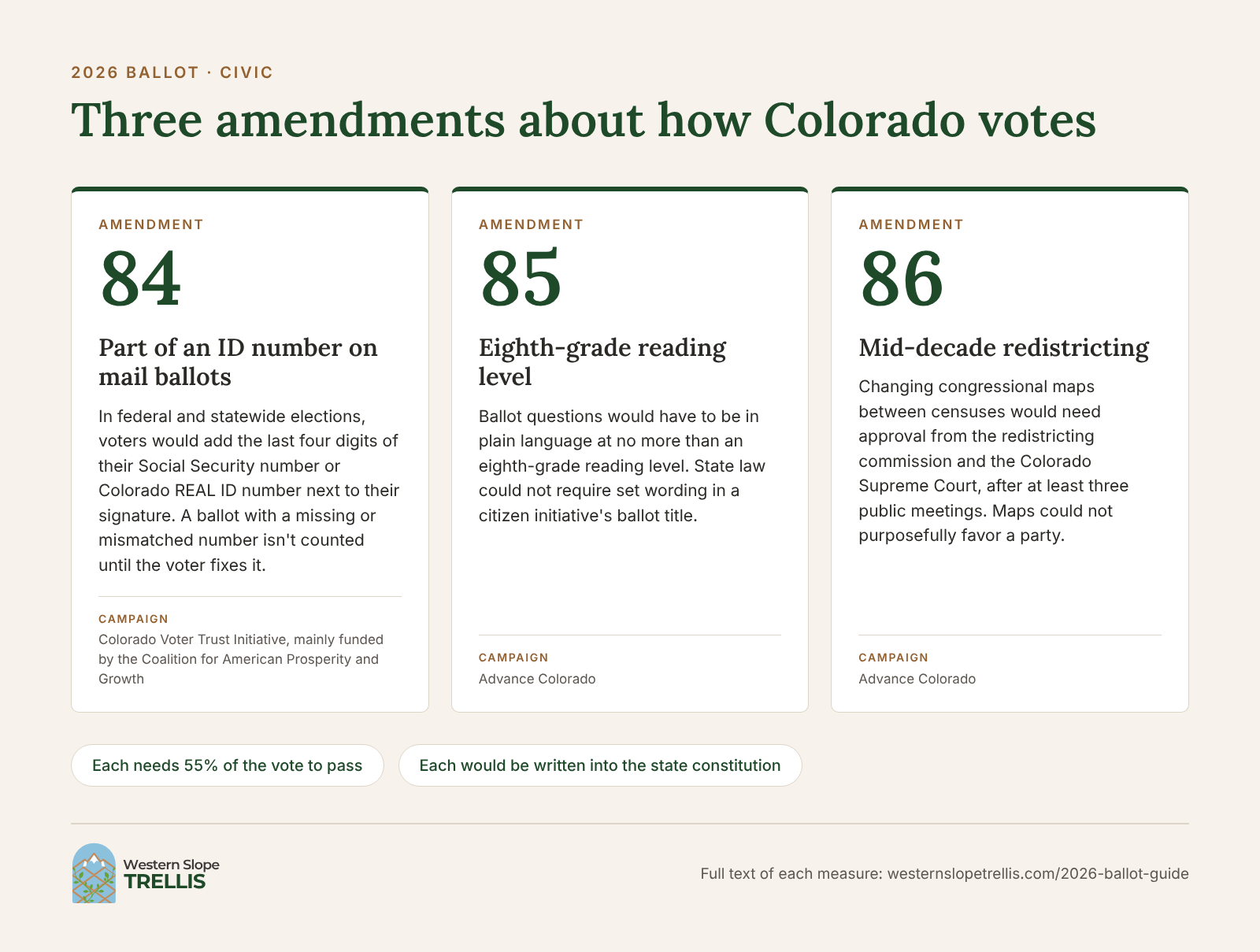
Most of this year's ballot asks what Colorado law should say. Three amendments ask how Colorado votes. Amendment 84 would add part of an ID number to mail ballots in federal and statewide elections, Amendment 85 sets a reading level for ballot questions, and Amendment 86 limits redistricting between censuses. All three are constitutional amendments, so each needs 55% to pass. Amendments 85 and 86 come from Advance Colorado, the group behind six of the 13 citizen initiatives on the ballot. Amendment 84's campaign is funded mainly by the Coalition for American Prosperity and Growth.
Amendment 84: part of an ID number on your mail ballot
Under Amendment 84, voters returning a mail ballot in a federal or statewide election would still sign the envelope and would also write the last four digits of their Social Security number or of a Colorado REAL ID driver's license or ID card. If the number is missing or doesn't match the voter file, the clerk notifies the voter and can't count the ballot until it's fixed. Voters fix it in person or online with a copy of an accepted ID, such as that license, a U.S. passport, a military ID or a tribal photo ID. Older voters and voters with disabilities covered by federal accessibility law can use any ID state law already accepts.
The proponents are former deputy secretary of state Suzanne Taheri and former El Paso County clerk Chuck Broerman. Their campaign committee, Colorado Voter Trust Initiative, had raised $4.2 million through Sept. 21, including $2.25 million from the Ohio-based Coalition for American Prosperity and Growth, Colorado Politics reported.
Both sides point to Mesa County. In 2024, a postal worker and another woman stole mail ballots and returned them with forged signatures. Most were flagged in signature review, and the scheme came to light when the clerk's office contacted those voters to fix the signatures and they said they hadn't voted. Three of the ballots passed signature review and were counted. Both women were prosecuted. Taheri cites the case for the amendment; state election officials at the time pointed to it as the system's layers of security working.
Supporters say handwriting is the weak link. Taheri told CPR News that signature matching is subjective. "This is basically a two-factor authentication," she said. She argues that with a second check in place, clerks could loosen signature matching and reject fewer legitimate ballots.
The League of Women Voters is opposed. "This will not make our elections safer. It just makes them harder to navigate for voters," executive director Beth Hendrix told CPR, warning that clerical mismatches would put valid ballots at risk.
Young voters are where a new check could add friction. In August, Clerk Bobbie Gross's office announced outreach to about 4,000 voters ages 17 to 25 with one or no reference signature on file, so their ballots aren't rejected at higher rates. The practical question for Mesa County is how the two checks would work together: whether a number catches what a signature misses, and how many voters with a mismatch would fix it within the cure window, which closes eight days after each election.
Amendment 85: eighth-grade ballot questions
Amendment 85, from Advance Colorado, requires ballot questions to be in plain language at no more than an eighth-grade reading level. It also bars state law from requiring set wording before, after or inside the ballot title of a citizen initiative. The practical questions are who measures reading level, and what happens to a legally precise phrase that scores at grade eleven.
Amendment 86: redistricting between censuses
Amendment 86, also from Advance Colorado, sets rules for redrawing congressional lines between censuses. Starting with the 2028 election, any change would need approval from the independent redistricting commission and adoption by the state Supreme Court, after at least three public meetings. A new map could not divide communities of interest or purposefully favor a party.
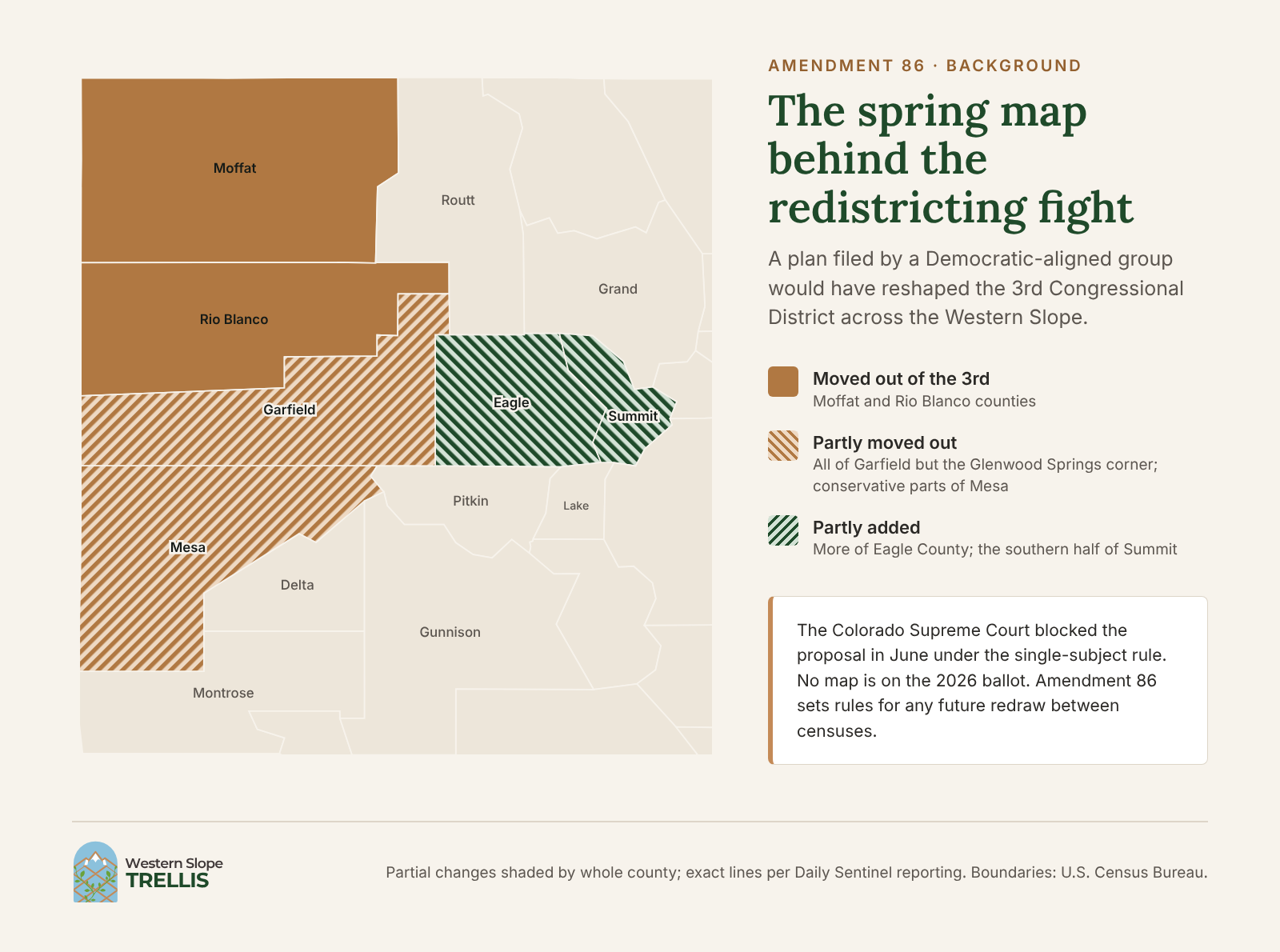
The fight it grew out of ran through the Western Slope and Mesa County. A plan filed this spring by Coloradans for a Level Playing Field, a Democratic-aligned group, would have moved Moffat, Rio Blanco and all of Garfield County except the Glenwood Springs corner out of the 3rd Congressional District, along with conservative parts of Mesa County. It would have added more of Eagle County and the southern half of Summit County, the Daily Sentinel reported, a change that could flip the seat now held by Republican Rep. Jeff Hurd. Advance Colorado argued the measures violated the single-subject rule, and in June the Colorado Supreme Court blocked them from the ballot. No map is on this ballot. Amendment 86 is a rule for next time, and it would bind both parties.
Reading them together
Each of the three writes procedural rules into the constitution. The redistricting commission is already there, but signature checks and most ballot-title rules now live in state law, which the legislature can adjust. Once these rules are in the constitution, changing them takes another statewide vote: 55% to amend, or a simple majority to repeal. Whether that is protection or rigidity depends on how much you trust the current system. The voter guide has the full text of each.
Last in the series: Propositions 133, 134 and 135 on trafficking, school sports and surgery for minors.