For almost 40 years, Colorado has clung to a single, unbending rule for income taxes: everyone pays the exact same rate. Whether you're a line cook pulling shifts in Clifton or a private equity partner with a second home in Aspen, the state takes the same 4.4% slice of every dollar you earn.
That could change this November.
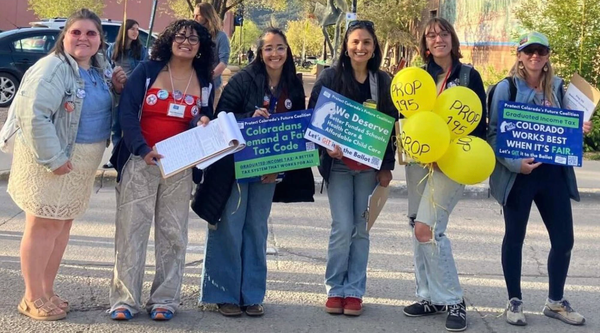
A coalition backing Initiative 195 just dropped over 157,000 signatures on the Secretary of State's desk, well past the threshold needed to make the ballot. Their pitch is straightforward. They want to scrap the flat tax and roll out a progressive system where the wealthiest Coloradans pay more, and nearly everyone else pays a little less. Since this would amend the state constitution, it will take 55% of the vote to pass.
The Math Behind the Measure
The initiative replaces the current flat rate with six new tiers starting in tax year 2027.
| Portion of Taxable Income | Current Rate | Rate Under 195 |
| Up to $25,000 | 4.4% | 3.7% |
| $25,001 to $100,000 | 4.4% | 4.2% |
| $100,001 to $500,000 | 4.4% | 4.4% |
| $500,001 to $750,000 | 4.4% | 7.4% |
| $750,001 to $1 million | 4.4% | 7.9% |
| Above $1 million | 4.4% | 8.4% |
People often hear about higher tax brackets and panic, thinking a bump in pay means their entire income gets taxed at a much steeper rate. It doesn't work that way. These are marginal rates. If you miraculously pull in $600,000 next year, you aren't paying 7.4% on all of it. You pay the same lower rates as everyone else on the first $500,000. That 7.4% rate only kicks in on the very last $100,000 you earn.
What it Means for the Western Slope
Let's be real about the local economy: almost nobody out here is brushing up against that half-million-dollar threshold. Median household incomes across Mesa, Montrose, and Garfield counties sit closer to $73,700.
Because of that, the vast majority of our neighbors would actually get a tax break. If your taxable income is $50,000, your state tax bill would edge down from $2,200 to $1,975. A household making roughly the statewide median of $95,000 would see its effective rate drop to about 4.07%. Even at $150,000, you're paying a few hundred dollars less.
It's not a life-changing windfall for the middle class. But on the upper end, a family bringing in $1.2 million a year would owe about $24,000 more.
All those extra dollars at the top add up. The state estimates Initiative 195 would generate upwards of $2 billion annually. By law, that money gets locked into a dedicated, audited fund explicitly meant for K-12 schools, health care, and early childhood programs.
Those are systems we rely on heavily out here, and they are visibly cracking. Mesa County Valley School District 51 is staring down a $5.6 million shortfall. Down the road, Delta Health had to indefinitely shutter its labor and delivery unit because the finances simply didn't work, leaving expectant mothers driving to Montrose or Grand Junction. Meanwhile, the state just slashed hundreds of millions from Medicaid to balance its budget—a direct hit to the roughly 63,000 people enrolled across Mesa, Garfield, and Montrose counties.
"There's often this perception of western Colorado that we're anti-tax, but what I think people really want is an effective tax system. They want to know that their tax dollars are being spent effectively on things that we need." — Tyler McDermott, Western Colorado Alliance
The Pushback
Business groups, however, argue that changing the rules will drive high earners across state lines. The Common Sense Institute warns that an 8.4% top rate would stick Colorado with the highest taxes in the region. They project a steady trickle of lost businesses and up to 4,200 lost jobs tied to top-bracket firms as wealth migrates away.
"Coloradans don't want to chase revenue out of the state," argued Michael Fields of Advance Colorado, which is backing a rival measure to permanently cap our rate at 4.4%.
Still, supporters of 195 point out that the same economic models predicting job losses also project Colorado gaining nearly 400 new individual taxpayers overall. They also note that a massive chunk of the new corporate revenue would come from businesses based out of state, largely sparing local mom-and-pop shops.
When ballots arrive this fall, voters will have a choice to make. Keeping the flat tax maintains a familiar status quo—but over the last three years, that status quo has forced the state to close billion-dollar budget holes by cutting the exact schools and health programs rural communities lean on.
You can dig into the official arguments when the state Blue Book hits your mailbox, or plug your own salary into the campaign's calculator at protectcoloradosfuture.com to see how your bottom line would change.