April 8 Montrose Forum Highlights Mounting Strain on Agriculture and Water Supply
At an April 8 forum in Montrose, leaders including Sue Hansen and local farmers warned that drought, rising costs, and land pressures are putting agriculture at risk. The discussion highlights urgent challenges facing the Western Slope’s economy.
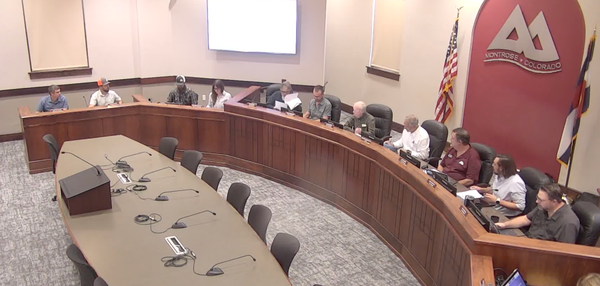
At The Forum held April 8 on the Montrose campus of Colorado Mesa University, local leaders, farmers, and water managers delivered a sobering assessment of the challenges facing agriculture in Montrose County. Through a series of presentations, speakers outlined how drought, rising costs, and long-term structural pressures are converging at a critical moment for the region’s agricultural economy.
Agriculture Still Anchors the Local Economy
Opening the forum, Montrose County Commissioner Sue Hansen emphasized the continued importance of agriculture to the region. She pointed to recent data showing roughly 150 farms producing nearly $88 million in agricultural output.
“What I want you to understand is how important this is to Montrose County,” Hansen said. “Sometimes we forget about it… people look at our ag land as open space, but these are working, producing farms.”
Her remarks framed the conversation around a central tension: agriculture remains foundational, but it is increasingly under pressure.
A Growing Sense of Strain Among Producers
Hansen shared a recent conversation with a local farmer that underscored the emotional and economic strain facing producers.
“He said, ‘I think this is the first time ever that I’ve lost my passion for farming,’” Hansen told the audience.
She connected that sentiment to broader challenges, including rising input costs, ongoing drought, and state-level policies that she said are making it more difficult for producers to operate.
“It’s just one depressing bill after another,” Hansen said, referring to legislative proposals affecting agriculture. “We’re making it harder and harder for our producers to make a living.”
Generational Transition and Land Pressure
Hansen also highlighted the long-term risks facing agriculture, particularly around land use and generational transition.
“That land is usually a producer’s 401k,” she said, explaining why many farmers ultimately sell to developers.
With land prices rising and many producers nearing retirement age, fewer young farmers are able to enter the industry or take over existing operations. The result is a gradual loss of working farmland across the region.
A Producer Perspective: Etchart Livestock
Local rancher George Etchart offered a firsthand look at what those pressures mean on the ground. Representing a second-generation sheep operation in the Uncompahgre Valley, Etchart described both the resilience and the challenges of staying in agriculture.
“If a farmer and a rancher is making money, they’re going to stay in business,” he said. “If not, it takes the wind out of your sail.”
He noted that recent years have been particularly difficult for the sheep industry, with producers struggling to cover expenses. At the same time, operations are being forced to make major decisions, including moving away from public grazing lands due to increasing pressures and uncertainty.
Decades of Adaptation in Local Agriculture
Longtime agricultural leader Nancy Fishering provided broader context, describing how Montrose agriculture has repeatedly adapted over time.
“We adapted,” Fishering said, pointing to past shifts from sugar beets to barley, and later to commercial vegetable production.
However, she warned that today’s challenges are different in scale and complexity. From labor shortages to regulatory requirements and rising costs, producers are being asked to manage more variables than ever before.
“This is not a new kind of trend,” she said. “But right now, it’s very close to recession numbers.”
Historic Drought Conditions
Water availability emerged as one of the most urgent concerns discussed during the forum. Steve Pope, general manager of the Uncompahgre Valley Water Users Association, described the current conditions in stark terms.
“This is the worst year on record,” Pope said.
He explained that snowpack levels are so low that some monitoring stations are no longer reporting data, and runoff projections have dropped dramatically.
“We are not planning on any water from the Uncompahgre system this year,” Pope said, noting that irrigation will rely heavily on limited alternative sources.
Immediate Impacts on Farms
The consequences of those water shortages are already being felt. Farmers may be forced to leave large portions of their land unplanted this season.
“If you had a small business and you’re going to cut it in half this year, it’s just tough,” Pope said.
Fishering added that the region is no longer dealing with isolated drought years.
“You can survive a one-year drought,” she said. “This is a 20-year drought.”
Aging Infrastructure and System Challenges
Pope also pointed to the limitations of the region’s aging irrigation infrastructure. Much of the system is more than 100 years old, and maintaining it has become increasingly difficult.
“There is no other alternative,” he said, explaining that local producers cannot afford the cost of large-scale improvements without outside funding.
A Call for Community Awareness and Action
Throughout the forum, speakers emphasized that the broader community has a role to play in supporting agriculture.
Hansen encouraged residents to better understand the industry and consider small changes, especially around water use.
“Every little bit helps,” she said.
Looking Ahead
The April 8 Forum made clear that agriculture remains central to Montrose County’s economy and identity. At the same time, the combination of drought, economic pressure, and land use change presents a significant challenge for the future.
As Hansen put it, the question now is how the community responds, and whether it can find ways to support the farmers and producers who continue to sustain the region.