Water, Power, and Public Costs at Stake as Data Center Debate Heats Up in Colorado
As large data centers expand across Colorado, more than 50 organizations are urging lawmakers to adopt stronger guardrails. Supporters of SB26-102 warn that unchecked growth could strain water supplies, raise electricity bills, and shift long-term costs onto families and small businesses.
A new bill backed by the Western Colorado Alliance and a broad statewide coalition is putting environmental protection and consumer safeguards at the center of Colorado’s fast-growing data center debate.
Senate Bill 26-102, titled the Measure to Ensure Accountability for Large-Load Data Centers, was introduced on February 11 by Sen. Cathy Kipp and Rep. Kyle Brown. Supporters say the bill creates commonsense guardrails around an industry that is rapidly expanding across Colorado, including in rural communities on the Western Slope.
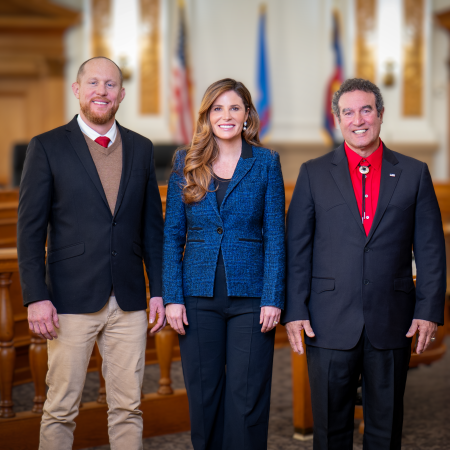
Rep. Kyle Brown and Sen. Cathy Kipp
Rather than offering long-term tax exemptions to attract developers, SB26-102 would require large data centers to pay for grid interconnection and infrastructure upgrades they require, preventing these costs from being shifted to residential ratepayers, maximize and pay for renewable energy, practice smart water consumption, and comply with reporting and transparency requirements. It also includes provisions to protect disproportionately impacted communities and ensure robust public engagement.
For the Western Colorado Alliance, water is one of the most urgent concerns.
“Rural communities stand to lose the most if Colorado doesn’t get the data center boom right,” said Barbara Vasquez, a board member of Western Colorado Alliance in Jackson County. “We need fair rules in place to make sure tech companies can’t drain our river basins dry and strain our electric grid. Even without data center impacts, water scarcity already threatens our way of life, and rural electric bills are some of the highest in the state. The industry needs guardrails.”
Water use at data centers can be significant, particularly when facilities rely on evaporative cooling systems. In arid regions like the Western Slope, where drought and overallocated river basins are already part of daily life, advocates argue that large new industrial water demands require clear standards and oversight. SB26-102 would require operators to report annual water and electricity use to the state no later than June 30, 2028, and each June 30 thereafter, and it gives local governments authority to require more efficient cooling technologies during permitting.
Sen. Cathy Kipp said Colorado already hosts large data centers and that more developers are actively seeking sites. “Without some basic protections in place, these projects place too much risk on the shoulders of Colorado families and small businesses,” she said. “Our bill ensures that won’t happen.”
Rep. Kyle Brown emphasized that energy and water systems are interconnected challenges. “Massive data centers add incredible pressure to our power grid and water systems, challenges we can’t ignore,” he said. “This legislation gives Colorado the commonsense guardrails we need to protect our communities and guide smart development.”
Supporters point to rising load forecasts as evidence that the stakes are real. In 2025, Xcel Energy recently estimated that data centers could drive an increase of more than 30 percent in peak power demand by 2035. At the same time, recent long-term rate modeling indicates commercial and industrial rates may decline over the next five years, while residential rates could rise by more than 25 percent by 2031.
“Residential ratepayers of all ages are feeling the pinch as the cost of living rises,” said Sara Schueneman, AARP Colorado state director. She argued that consumer protections are needed before households are forced to choose between paying electric bills, buying groceries, or refilling prescriptions.
SB26-102 would apply to facilities with a peak load of more than 30 megawatts and to clusters of facilities with large combined loads. Beginning in 2031, covered operators would be required to meet 100 percent of their annual electricity use with renewable energy. They would also be responsible for grid investments directly attributable to their demand.
Energy feasibility has become a central point of contention. Some lawmakers have questioned whether requiring 100 percent renewable energy is realistic, citing the terawatt scale of projected industry growth nationwide. WCA supporters respond that while industry-wide demand may eventually reach that level, individual data centers typically operate in the 20 to 50 megawatt range, with larger facilities approaching 100 megawatts. While that is enough electricity to power tens of thousands of homes, advocates argue that matching that scale with dedicated renewable generation and storage is technically achievable, particularly if required at the outset.
At the same time, a competing proposal, HB26-1030, would offer a state sales and use tax exemption for 20 years, with the possibility of a 10-year extension if conditions are met. Local governments would have to decide separately whether to adopt similar exemptions.
Kathy White, Executive Director of Colorado Fiscal Institute, warned against locking in decades-long tax subsidies. “Data center tax breaks have exploded into runaway giveaways in other states,” she said. “SB26-102 prioritizes Coloradans because it doesn’t lock in massive subsidies for some of the most profitable companies in the world while families struggle with rising costs and underfunded schools and healthcare.”
Environmental groups including Earthjustice, NRDC, Conservation Colorado, and Western Resource Advocates have joined the Western Colorado Alliance in supporting the bill. More than 50 organizations recently signed a letter urging lawmakers and Gov. Jared Polis to adopt policies that hold large technology companies accountable for the environmental and financial impacts of data center development.
“Colorado shouldn’t be the Wild West for data center developers,” said Stacy Tellinghuisen of Western Resource Advocates. “This bill makes them pay their fair share, protects families from higher utility bills, and establishes strong standards for clean energy, efficient water use, and community protections.”
As SB26-102 moves to the Senate Transportation and Energy Committee, Western Slope advocates are framing the debate as a choice between proactive safeguards and reactive cleanup. For communities already facing water scarcity, rising utility costs, and tight public budgets, they argue that the time to set enforceable environmental and fiscal guardrails is now.